Drift Hunters & Traffic Racing
- 4.0
- Rating
- 5.00M
- Installs
- Free
- Price
 Analysis by App-foxy
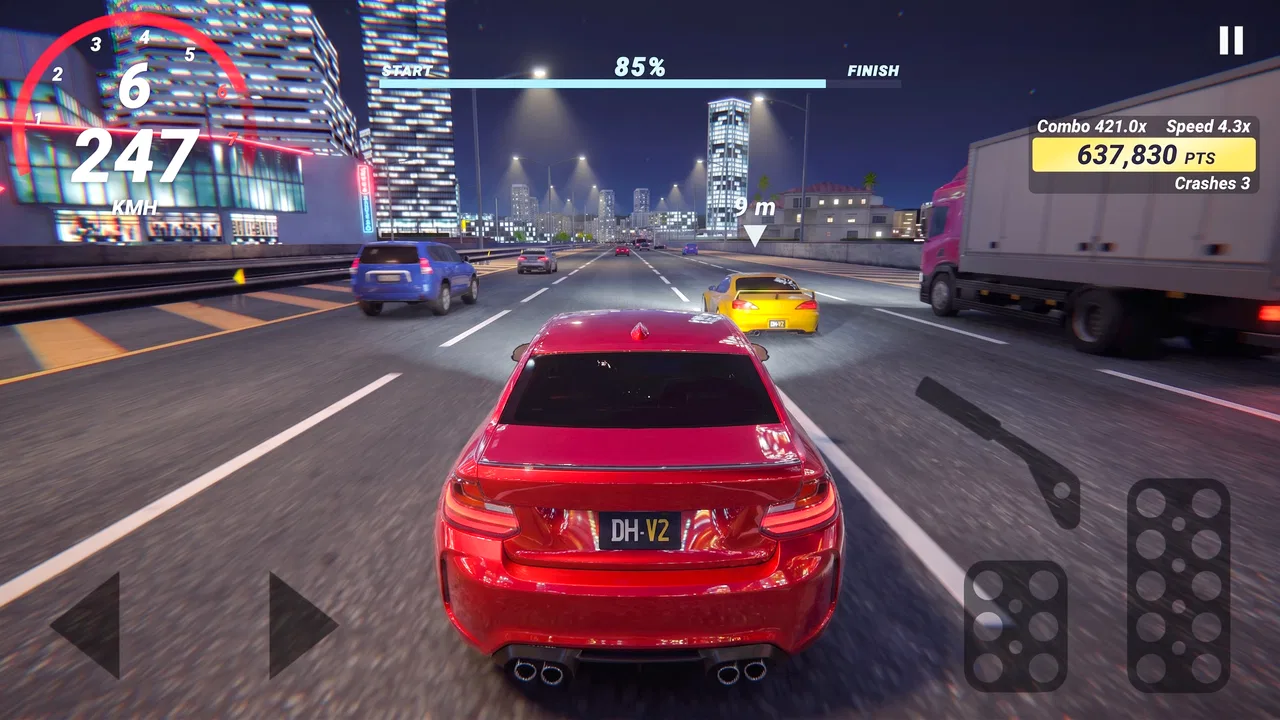
I approached Drift Hunters & Traffic Racing as the sort of game you open when you want driving to feel more involved than simply holding the accelerator. It is a free racing game from Illia Kaminetskyi, built around drifting, highway traffic, nighttime driving, car battles, and tuning. That combination gives it a more focused personality than a conventional lap racer, but it also means the right audience is fairly specific.
My main test was simple: does it make a short break enjoyable, and does it offer enough control to reward players who want to improve rather than just collect quick wins? I found that its appeal comes from the relationship between speed and restraint. A good run is not only about going fast; it is about choosing when to slide, when to straighten the car, and when traffic makes a risky move not worth taking.
The game is free to download and carries an Everyone age rating. It has passed 5 million installs, with an average rating of 4.0 from around 23 thousand ratings. Those figures suggest a broad audience, but they do not remove the need to choose carefully. If you want a structured championship with a large career system, another type of racing game may suit you better. If you enjoy experimenting with a car and surviving busy roads at night, this is much easier to recommend.
You May Also Like

 Blood Strike: 2.5 Anniversary
Blood Strike’s Loadouts Turn Every Drop Into a Tactical Gamble
A close look at Blood Strike’s custom loadouts: how fast access to signature weapons reshapes its battle royale rhythm, rewards preparation, and narrows the gap between fights.

 Pandora - Music & Podcasts
Pandora’s Music Is Easy to Start, but Harder to Recover
Pandora’s strength is its low-effort path from a seed to a station. Its weak spot is how much confidence it asks you to place in connection, setup, and quiet recovery.

 8 Ball Pool
 Is Built on Rivalries, Rematches, and Routine
A close look at the rivalries, rematches, shared routines, and unanswered safety questions that turn a quick pool match into a persistent mobile community.

 Samsung Music
’s Quiet Strength Is Playing What You Already Own
Its reach comes less from spectacle than from dependable access to a personal library. That simplicity is both the app’s strongest retention engine and its ceiling.

 AccuWeather: Weather Radar
AccuWeather Review: A Quick, Clear Forecast for Everyday Decisions
For everyday plans, the best forecast is the one you can understand quickly. AccuWeather makes rain timing, radar, and local conditions easy to act on, with a few trade-offs.

 Hill Climb Racing
Why Hill Climb Racing Still Turns Crashes Into One More Run
A tiny car, a bumpy hill and one more upgrade: Hill Climb Racing keeps resurfacing because its simple chaos makes every near-miss feel personal.
More From Our News Desk



What to judge before choosing this racer
Before installing, I would decide what kind of driving experience I actually want. There are three useful questions. Do I prefer drifting to clean cornering? Do I enjoy open traffic more than fixed circuits? And am I comfortable learning through repeated attempts instead of expecting every run to feel immediately smooth?
This game makes sense when the answer to those questions is mostly yes. The road is not merely a route between races; traffic becomes part of the challenge. A clear stretch invites speed, while a cluster of vehicles forces a decision about positioning and timing. That creates tension without requiring a long session, which is one reason I found it convenient for casual play.
It is also worth considering how much tuning matters to you. The attraction is not only reaching the finish. Adjusting a car and then feeling a difference in how it behaves gives the game a workshop-like side. Players who enjoy changing a setup, testing it, and refining their approach will get more from it than players who want every vehicle to feel almost identical.
Controls are another deciding factor. Drift-focused games can feel awkward until your hands learn the relationship between steering, speed, and sliding. I had to stop treating every bend like a normal racing corner. A small correction can preserve a drift, while an exaggerated input can turn a controlled slide into a loss of direction. That learning curve is part of the enjoyment, but it can be frustrating if you want instant precision.
The current version is 2.1.2 and the minimum operating system is Android 8.0. That makes the compatibility requirement fairly clear for Android users. I would still check the device experience before committing time to a long tuning session, especially if the phone is older or the display is small. Driving games depend heavily on responsive input, and even a good design feels less satisfying when controls are cramped.
How the driving loop feels in practice
The basic rhythm is easy to understand. I enter a nighttime road environment, build speed, look for space between traffic, and use corners or open sections to create a drift. The challenge comes from keeping the car under control while the road keeps presenting new obstacles. It is a more active loop than a simple straight-line traffic game because I am constantly balancing risk against momentum.
One useful habit is to read the road several seconds ahead instead of reacting only to the vehicle immediately in front. When traffic begins to compress, I found it safer to prepare a line early rather than make a sudden steering change beside another car. This is a small technique, but it changes the game from frantic swerving into deliberate driving.
Another practical tip is to avoid chasing the longest possible drift every time. A short, clean slide that leaves the car aligned with the next opening is often more valuable than a dramatic angle that sends the vehicle toward traffic. The game rewards style, but control has to come first. That trade-off is easy to miss when starting out.
I also recommend treating tuning as a testing process rather than a one-time upgrade screen. Make one change, drive the same kind of road, and pay attention to whether the car becomes easier to place. Changing everything at once makes it difficult to understand what helped. This approach is especially useful for players who are new to drift games, because it turns vague handling problems into manageable experiments.
Where this game is strongest
The clearest strength is its blend of drifting and traffic. Many racing games separate these ideas: one asks for perfect laps, another asks for endless highway survival, and a third focuses on customization. Here, the road itself becomes the place to practice control. I can use an open section to build confidence, then test that confidence when traffic removes the comfortable margin for error.
The nighttime setting also supports the mood. It makes the road feel less like a formal circuit and more like a place where every gap matters. I found that this atmosphere works particularly well during short sessions, because the game establishes its identity quickly. I do not need a lengthy story or a large menu system to understand what I am supposed to enjoy.
Car battles add another layer to the driving fantasy. They make the experience feel more competitive than simply chasing a personal score, while still keeping the focus on road control. The important point is that the game’s appeal is not based on one isolated feature. Drifting, traffic, tuning, and battles reinforce one another, creating a compact package for players who like a hands-on driving loop.
The tuning element is valuable for another reason: it gives repeated attempts a purpose. If a run goes badly, I can think about whether the problem was my timing, my line, or the way the car was set up. That makes failure more informative than in a racer where the only answer is to try the same vehicle again and hope for a cleaner run.
The best part is the feeling of turning a dangerous gap into a controlled decision. That is more specific and satisfying than simply watching a speed number rise. When the car slides into position, avoids traffic, and exits the maneuver facing the right direction, the result feels earned.
Small techniques that make a big difference
First, I would learn a route by driving it conservatively before attempting aggressive drifts. The purpose is not to set a record; it is to notice where traffic tends to reduce the available space and where the road gives enough room to recover. Once those points become familiar, it is easier to choose where to take risks.
Second, use the edge of a drift as a warning rather than waiting for a complete mistake. If the car begins rotating more than intended, correcting early is usually less costly than trying to rescue it at the last moment. This is especially important near traffic, where a minor loss of control can become a collision very quickly.
Third, separate the goals of earning style and staying alive. If I am practicing a new setup, I focus on clean positioning and repeatability. If I am trying to make progress, I reduce unnecessary risks. Mixing both goals in every run can make the game feel harsher than it needs to be.
Finally, I would not judge a car after one short attempt. A different setup can change how much steering correction feels necessary, and unfamiliar handling can initially seem worse simply because it demands a different rhythm. Give the car enough time to reveal whether it is genuinely difficult or merely different from the previous one.
How it compares with other racing choices
The most common alternative is a traditional circuit racer. That type of game is usually better for players who want clear laps, predictable corners, overtaking points, and a strong sense of formal race progression. If your satisfaction comes from braking at the same marker every lap and improving a clean racing line, Drift Hunters & Traffic Racing may feel too loose and reactive.
On the other hand, a pure arcade racer often makes speed and spectacle the main priorities. Those games can be easier to pick up because the handling is forgiving and the action is immediately dramatic. This game asks for more attention to weight, angle, and traffic spacing. I prefer that when I want driving to feel like a skill, but I would choose a simpler arcade option for a quick, low-effort session.
Endless highway games are another nearby category. They are often excellent at creating a straightforward “how long can I last?” loop. This game has more variety in the driving fantasy because drifting and tuning give me additional reasons to replay a road. The trade-off is that its controls and decisions require more involvement. Someone who only wants to weave through traffic without learning drift behavior may find the extra handling layer unnecessary.
There is also a difference between this game and large simulation-oriented racers. A simulation usually appeals to players who want detailed vehicle behavior, organized events, and a broader motorsport structure. Here, the emphasis is narrower: nighttime roads, sliding cars, traffic, battles, and customization. That focus is a strength if those are the features you came for, but it is not a replacement for a complete racing career.
In everyday use, I imagine opening it during a commute break or after work, playing several attempts, and closing it without needing to remember a complicated storyline. A player who enjoys tuning might stay longer, trying to make a car easier to control through traffic. A player who dislikes repetition may leave sooner, because the core pleasure comes from refining the same driving skills rather than constantly discovering unrelated activities.
Who should install it, and who should skip it
I would recommend it to someone who likes drifting more than perfect lap times, enjoys the pressure of moving traffic, and wants a free game that can be played in short bursts. It is also a good fit for players who enjoy learning a vehicle through trial and error. The combination of tuning and road battles gives those players a reason to keep testing their technique.
I would be more cautious about recommending it to a player looking for a deep story, licensed motorsport structure, or a large collection of distinct event types. Those expectations point toward a different kind of racing game. I would also suggest skipping it if you find repeated control practice irritating. Drifting is not something I mastered instantly, and the game is less enjoyable when every failed attempt feels like wasted time rather than feedback.
The Everyone rating makes it accessible from an age-classification standpoint, but that does not mean every player will find the driving easy. Younger or less experienced players may need time to understand why a car that appears fast can still be difficult to place. A patient approach helps more than aggressive steering.
Free access, purchases, and the real cost of changing games
The game is free, which lowers the barrier to trying it. That matters here because handling preference is personal. A description can tell me that drifting and tuning are central, but only actual play reveals whether the controls feel natural in my hands. I would install it with the intention of giving the driving loop a fair trial rather than judging it after a single awkward corner.
In-app purchases range from $1.99 to $49.99 per item. That is a wide span, so anyone who dislikes optional spending should decide on a personal limit before browsing purchase screens. The important practical question is not simply whether the download costs nothing; it is whether the free experience already provides enough enjoyment without creating pressure to spend.
I also think about the cost of switching from another racer. If I am coming from a circuit game, I have to retrain myself not to brake and steer as if every corner has a fixed ideal line. If I am coming from an endless traffic game, I have to accept that surviving is only part of the challenge. The adjustment is not financial; it is a change in driving habits.
For that reason, I would not uninstall a favorite racer immediately. Keep both for a few days and use this one when you want drifting or traffic pressure. That makes the comparison fair. If you repeatedly return to the tuning and battles, it has earned a place on the phone. If you always prefer clean laps or effortless arcade speed, the alternative is probably the better use of storage and attention.
My recommendation after spending time with it
My recommendation is positive but specific: try it if the idea of controlling a tuned car through nighttime traffic sounds more appealing than completing conventional races. The game has a clear identity, and its best moments come from decisions that are easy to understand but difficult to execute consistently.
I would not call it the universal racing choice. Its focus can feel narrow, the learning curve may test your patience, and players seeking a broad career or formal circuit competition should look elsewhere. Those are not minor details; they determine whether the game feels purpose-built or limited.
For me, the free entry point makes that decision straightforward. Install it, spend enough time learning one car, and judge the experience after you have tried both cautious traffic runs and deliberate drifting. If you enjoy improving the connection between setup and control, the game can become a satisfying repeat-play racer. If you want instant speed with almost no adjustment, another category will serve you better.
Ultimately, I see this as a focused driving playground rather than an all-purpose racing collection. Illia Kaminetskyi has aimed it at the pleasure of sliding, tuning, and threading through traffic, and that focus is exactly why it works for the right player. Choose it for hands-on drift practice and tense road decisions, not simply because it is free.
FAQs for Drift Hunters & Traffic Racing
01What is Drift Hunters & Traffic Racing?
Drift Hunters & Traffic Racing is a driving game focused on two complementary experiences: controlled drifting and high-speed traffic racing. Players can practice slides, earn rewards, improve their vehicles, and compete against traffic while trying to achieve better distances, scores, or times. Its appeal comes from combining arcade-style driving with car customization and challenges that are easy to understand but require practice to master.
02Can I play Drift Hunters & Traffic Racing offline?
The game may allow some driving activities to be played without a constant internet connection, which is useful when traveling or when mobile data is unavailable. However, certain features can depend on online services, including advertisements, rewards, updates, leaderboards, cloud-related functions, or other connected content. For the most reliable experience, launch the game online after installation and check which modes remain available when your device is offline.
03Does the game offer car customization and upgrades?
Customization is an important part of the experience, especially for players who want to adjust a car’s appearance and improve its performance. Depending on the version and available progression system, you may be able to modify elements such as paint, wheels, handling, acceleration, braking, or drift control. Upgrades generally require in-game currency, so completing races and challenges efficiently is important before spending rewards.
04Is Drift Hunters & Traffic Racing suitable for beginners?
Yes, beginners can start playing without advanced knowledge of racing games, because the basic controls and objectives are straightforward. Nevertheless, drifting takes practice, since steering, acceleration, braking, and timing must be coordinated to maintain a long slide without losing control. New players should begin with slower cars or easier events, learn the handling model, and gradually increase difficulty as their confidence improves.
05Are there advertisements or in-app purchases?
Like many free-to-download mobile racing games, Drift Hunters & Traffic Racing may include advertising and optional in-app purchases. Ads can appear between activities or be offered in exchange for bonuses, while purchases may provide currency, upgrades, cosmetic items, or other progression advantages. Before downloading, review the current Google Play or App Store listing and your device’s purchase settings, particularly if children will be playing.
Pros
- Responsive drift controls make cornering feel satisfying.
- Wide car selection offers different handling styles to explore.
- Tuning options let players adjust performance and driving preferences.
- Traffic adds pressure and keeps otherwise simple races engaging.
- Short races are convenient for quick gaming sessions.
Cons
- Some cars and upgrades may require substantial in-game grinding.
- Traffic behavior can feel predictable after extended play.
- Drifting physics may seem slippery to players seeking realistic handling.
- Visual quality varies noticeably across tracks and environments.
- Ads or optional purchases may interrupt the overall progression.

Drift Hunters & Traffic Racing
Gallery